On the last day of any city break, one decision decides the itinerary: where the bags go, and the answer since the mid-2010s is usually an app-based storage network — a staffed shop or hotel desk booked by the hour for roughly €5–10 per bag per day in most European cities as of 2026 — with station left-luggage offices remaining the best option at the terminal itself. The three systems, their trade-offs, and the small print that matters are set out below.
This site publishes information, not professional travel advice; prices and availability change, so verify at your station or in the app you plan to use.
What are the three storage systems?
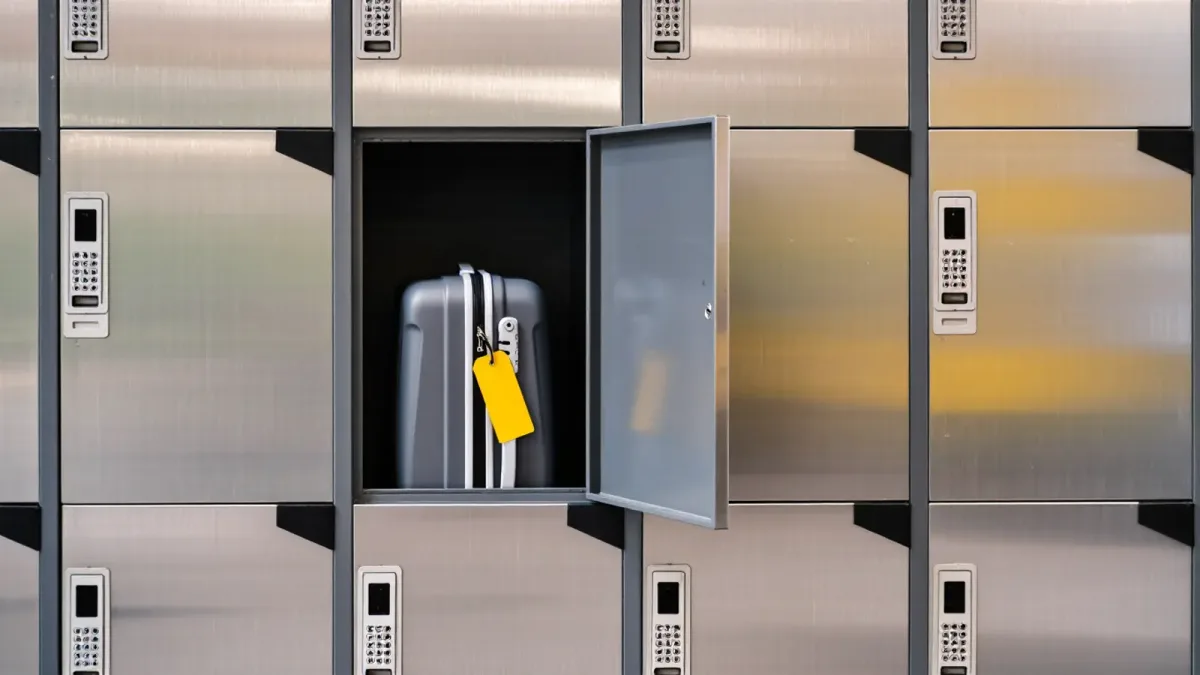
First, station left-luggage offices and automated locker banks, run by rail operators at major terminals: staffed or machine-operated, priced typically €6–12 per bag per 24 hours as of 2026, and uniquely suited to the hours between check-out and a departing train, because the bag is already where you finish. Second, app-based networks that list thousands of partner shops, hotels, and cafes — the model that spread across Europe and North America from the late 2010s — where a fixed per-bag daily fee, booked in the app, covers storage with insurance included; these suit the middle of the city, since partner shops cluster around the districts you are actually sightseeing in. Third, hotel storage: free for guests, but only worth planning around if your last-day route returns past the hotel anyway.
How do you choose between them?
Two questions settle it. Where does the day end? A trip that finishes at the station belongs to the station office; a day of districts and an evening departure from a bus terminal across town belongs to the app network's shop nearest your last stop. What does the bag weigh? App-network partners typically accept standard suitcases up to defined size limits and refuse outsized items, while station offices take almost anything; oversized luggage — skis, bicycles, golf bags — is a station-office transaction. Insurance cover differs too: app bookings include declared-value cover in the standard fee, while station offices vary by operator, so the receipt's terms matter for anything valuable.
What small print causes problems?
Four recurring ones. Opening hours: station offices shut in the evening while some app-network shops run late, but individual partners keep their own shop hours — a 19:00 closing shop is a missed-bus risk. Size limits: read the app listing before walking over with a large case. Peak-day queues: the biggest station offices at holiday peaks can produce 20-minute lines each way, which reframes the "free hotel storage" option. And the pickup party: app bookings are tied to the booker's QR code, so a friend collecting on your behalf needs the booking shared, not just a verbal description of the bag.
What about security, and what about the airport?
On security: both staffed offices and app-network partners operate custody chains — a receipt or QR record, a sealed or tagged bag, and defined insurance — which is a higher standard than the unattended-locker risk of decades past, though the guidance stands: never store passports, medications, or electronics in any storage you cannot personally supervise, and keep the day's essentials with you in a daypack. On airports: most major airports run their own left-luggage counters, priced above city rates but useful for the reverse problem — a long layover that allows a few hours in the city. The same reverse logic applies to early arrivals before hotel check-in, where the station office near the arrival platform remains the fastest and most predictable first stop in the city.
How does this shape the last day's plan?
Reverse-engineer it. Choose the drop point first — the shop near the morning's first district, not near breakfast — then build the day's route to end within a short walk of pickup, and leave 20 minutes of buffer before any onward connection. Travelers running the one-neighborhood-per-day structure get the cleanest version of this: each district's storage options stand on their own, so the last day's bags move once, in the morning, and never again. That single planning step is what converts the departure day from luggage logistics into a final half-day of the city — which is the entire point of the format.