The right airport transfer is the one that matches three variables you know in advance — arrival hour, luggage volume, and the price-time trade you prefer — and in most major cities the ranking is stable: express rail for speed at midday, metro or local rail for budget with light bags, licensed taxi or rideshare for late arrivals, early departures, and heavy luggage, with shared buses rarely the best option anymore. The framework below turns the airport's published options into one decision; figures reflect typical patterns across major European and East Asian airports as of June 2026.
This site publishes information, not professional travel advice; fares and schedules change, so check your airport's official page before flying.
What are the options, generally?
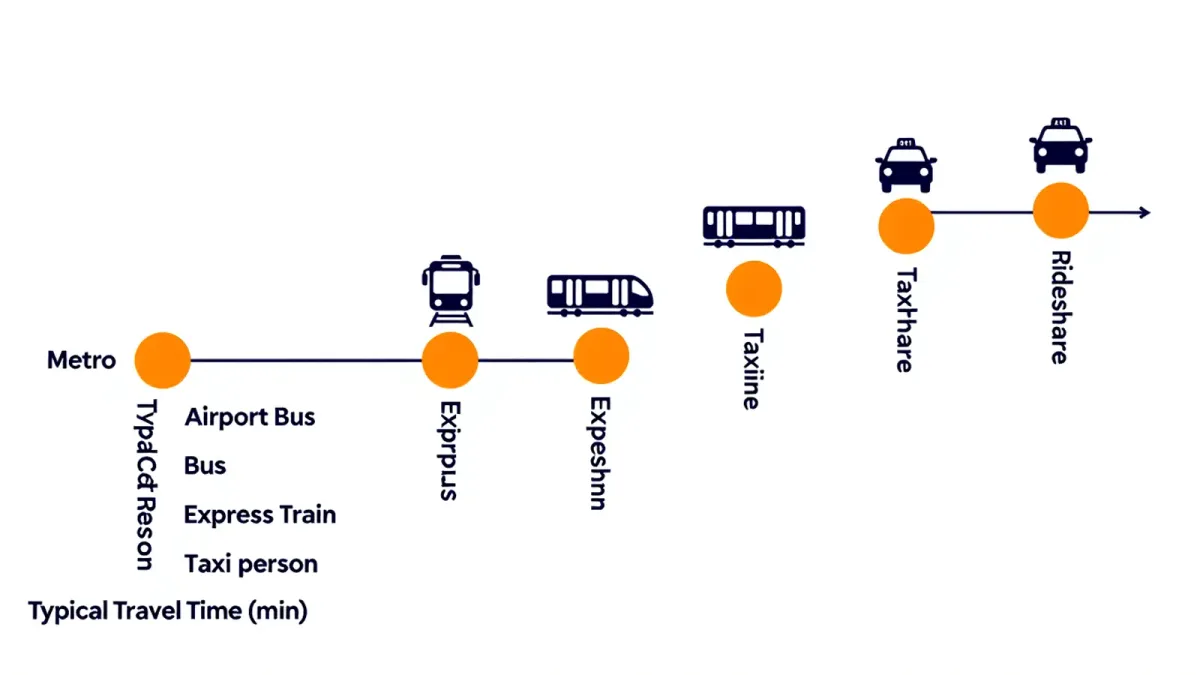
Most airports served by city breaks offer some or all of five: an express airport train (fastest, priced at a premium); the regular metro or commuter rail (cheapest per kilometer, slower with stops); scheduled airport buses (comfortable, but hostage to road traffic); licensed taxis with fixed or metered airport fares; and app-based rideshares where the city permits airport pickup. A comparison across a representative city puts typical one-way costs per person roughly as: metro 3–7 currency units, airport bus 6–15, express rail 8–20, taxi 30–55, rideshare similar or less outside peak — with travel times of 15–45 minutes depending on distance, distances that make the per-minute premium of a taxi steepest for one traveler and cheapest for a group of four splitting it.
How should you decide on the day?
Work the variables in order. Luggage first: more than a wheelie each pushes the metro out of contention at rush hour regardless of price. Arrival hour second: services on many airport lines thin or stop around midnight — an airport whose last express leaves before your flight lands is a taxi booking made in advance. Group size third: divide the taxi fare by travelers before comparing, since four people sharing often match the express train's door-to-door time once you count the walk between stations. Weather and strikes are the tiebreakers: a rail option you would normally take deserves a recheck when either is forecast.
What are the common mistakes?
Three repeat offenders. Booking a private transfer by default — the pre-booked car suits late arrivals and mobility needs, but at midday it usually costs several times the express train for the same corridor. Trusting rideshare pickup maps at unfamiliar airports: the designated app-collection zones move between terminals, and the airport's own page, not the app, is current. And ignoring the return leg: a 07:00 departure makes the transfer a taxi problem regardless of what the arrival leg used, since city transit may not yet be running — the single most common budget surprise in the whole airport equation.
Accessibility deserves its own line in the decision. Airport express trains and most metro systems now offer step-free routes from the airport platform to the city center, and the transit operator's accessibility page will confirm the interchange-by-interchange chain — worth checking because one stairs-only stop can void the whole route. Licensed taxis at the airport rank are the default for wheelchair users where wheelchair-accessible vehicles exist, but in many cities those vehicles must be booked by phone rather than hailed; the airport's own assistance desk arranges them, and under EU Regulation 1107/2006 the airport must provide arrival assistance free when requested 48 hours ahead. For any traveler with specific needs, the transfer is therefore not a price decision but a phone call made before departure — the difference between a 20-minute exit and a two-hour improvisation.
How do you pay, and what should you prepare?
Contactless cards now cover most of the rail-and-metro world's airport gates, and many systems cap daily fares automatically, so the arrival-day transit spend stops without effort; the exceptions are fixed-fare taxi zones, where you confirm the airport rate before boarding, and cash-ticket machines that remain common at bus bays. Two preparations smooth the rest: download the city's transit app before the flight, and screenshot the airport's terminal-to-station walking map, since the last 500 meters — not the transfer choice — is where arrival time is actually lost.