Shimokitazawa rewards the city-break traveler who wants a Tokyo neighborhood at walking pace: roughly 1,200 small shops, cafes, and theaters packed into low-rise blocks a few minutes by train from Shinjuku or Shibuya, best browsed on a weekday afternoon when the lanes are quiet. The district sits in Setagaya ward, northwest of Shibuya, and grew around two railway lines — the Odakyu Line and the Keio Inokashira Line — whose crossings cut it into a grid of short, mostly car-light streets. This primer covers the district's character, how to spend a half-day there, and the practical details that matter on a short visit. Selections below were chosen for walkability, variety, and price range as listed in December 2025.
As with any guide, this site publishes information, not travel-agency advice; hours and prices change, so confirm details before you go.
What kind of neighborhood is Shimokitazawa?
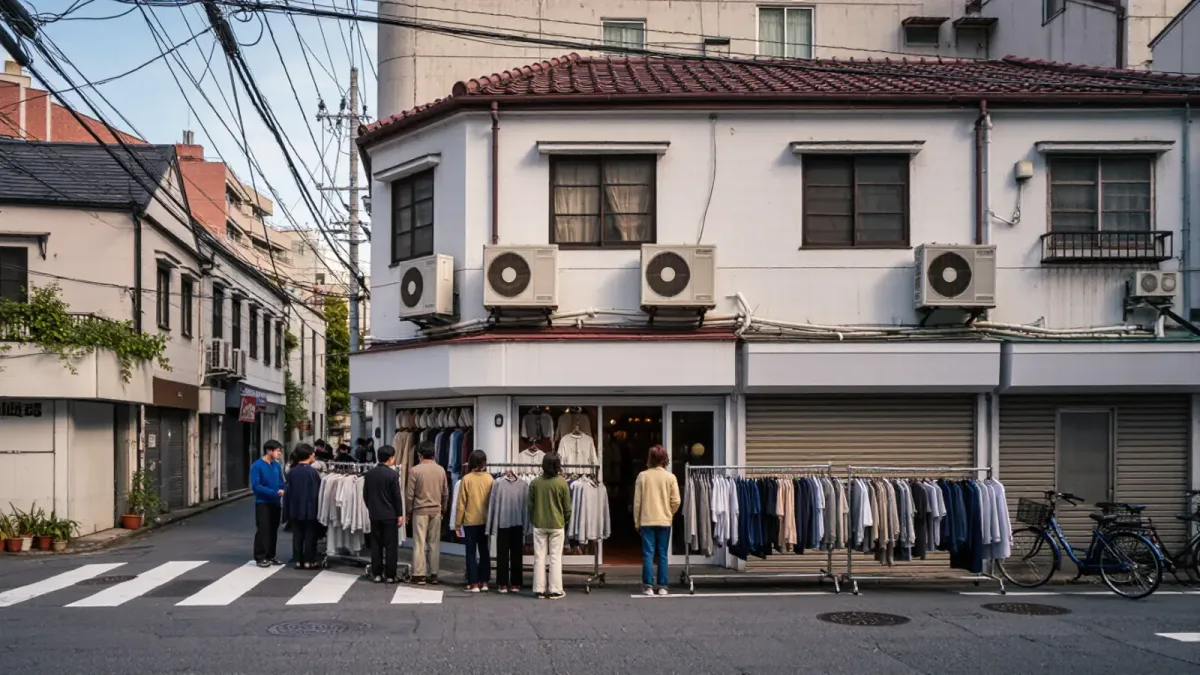
Shimokitazawa is Tokyo's established home of secondhand fashion and independent music. Decades of local organizing kept large developers out of much of the district after a planned expressway project was abandoned in the early 1990s, so the area kept its narrow lanes, small lots, and independent storefronts rather than the department-store skyline of Shinjuku ten minutes away. The result, as of 2025, is a district where vintage clothing shops, record stores, live houses, and curry restaurants cluster within a few hundred meters of each other — a density recognized internationally when Time Out named Shimokitazawa the world's coolest neighborhood in 2019, a label locals have worn with mixed feelings ever since.
How do you get there, and where do you arrive?
Two lines serve the district. The Odakyu Line runs from Shinjuku in about eight minutes on a local train; the Keio Inokashira Line runs from Shibuya in about eleven, stopping at Shinsen en route. Either way you arrive directly under the neighborhood: the south exit of Shimokitazawa Station puts you at the crossing locals call the south exit intersection, the district's de facto center. From the north exit, the covered Mizuki Dori arcade leads into the densest shopping blocks. Do not plan to drive; parking is scarce and the charm of the district is precisely that it was built before the car.
How should you spend a half-day?
Work outward from the station in a loop, because the district is small — a full circuit of the core streets takes under an hour even at browsing speed.
- North side: vintage and records. The blocks north of the station hold the highest concentration of secondhand clothing shops, from curated American workwear at collector prices to unsorted bins at thrift-shop rates, alongside record stores stocking Japanese pressings and imported jazz. Prices run from a few hundred yen for clearance vinyl to tens of thousands for collectible pieces; window-shop first, since stock turns over weekly.
- South side: cafes and curry. The lanes south of the station, around Suzunari and the Reva crossing, favor coffee roasters, bars, and curry restaurants. Shimokitazawa's curry scene is a local institution — the district has hosted its own Curry Festival since 2010s editions drew crowds, and dozens of shops compete within walking distance, with lunch sets typically in the ¥1,000–1,500 range as listed in late 2025.
- Theaters and stages. Théâtre Suzunari and the smaller Honda Gekijo anchor a cluster of small stages that give the district its evening audience. If your break includes a night here, same-day tickets are often available at the door for smaller productions.
When is the best time to go?
Weekday afternoons are the district at its best: shops fully open, lanes navigable. Weekends bring heavy foot traffic, and on occasional event Sundays the main streets close to cars under the local Music Street program, which is pleasant if you want atmosphere and frustrating if you are on a schedule. Most shops open around 11:00–12:00; the district has little to offer before noon except breakfast cafes, so plan Shimokitazawa for the afternoon and evening rather than the morning.
Any practical notes before you go?
Three small points save time. First, carry some cash: while cards are increasingly accepted in Tokyo, many of the district's smallest vintage shops and curry counters still favor cash, and the convenience-store ATMs near the station accept foreign cards. Second, the lanes are narrow and shop doors open onto the street, so leave large luggage at your hotel's storage rather than wheeling it through the crowds. Third, if a purchase is too bulky to carry, several shipping counters in the district's convenience stores send domestic parcels; as of late 2025 the standard service moves a box across Tokyo within a day or two.
How does it fit a Tokyo city break?
For a three- or four-day Tokyo break, Shimokitazawa pairs naturally with Shinjuku or Shibuya on the same day: shopping and lunch in the district, then onward by train to the larger centers for evening. It is the contrast that earns the visit — a village-scale grid of independent shops, at Tokyo prices' lower end, fifteen minutes from the biggest stations in the city.