City food markets reward a specific kind of attention: they are working retail spaces first and attractions second, and the traveler who treats them as shops rather than sights gets better food, better prices, and better conversations. The core method fits in five habits — arrive mid-morning on a weekday, carry small cash, taste what is offered before buying, buy little and often, and learn the two or three words vendors use for their best product that day (market hours and payment practice at major European covered markets as posted, January 2026). This guide walks through each, plus the etiquette that keeps a traveler welcome at the busy end of the hall.
This site publishes information, not dining advice; hours and customs vary by city and stall.
When Is the Right Time to Visit a Market?
Every market has a rhythm. The working morning — roughly 08:00 to 11:00 — brings chefs, regulars, and the fullest stalls; this is when vendors have time to talk and the produce is at its best. The lunch window brings the busiest crowds and prepared-food stands at their peak. The late-afternoon wind-down is when some vendors discount, but the pickings are thinner and the conversation shorter. Saturdays are the loudest and fullest at most European covered markets, and also the most crowded; a first visit on a weekday morning is the gentlest introduction (posted market hours, January 2026).
Cash or Card at Market Stalls?
The answer changes fast and varies by country: card and contactless payment now works at many permanent stalls in larger European cities, while cash remains king at smaller markets and farm stalls, and some vendors offer a small discount for it. The practical rule is to carry coins and small notes regardless — queues move faster, minimum-purchase signs become irrelevant, and the 12-euro card terminal minimum disappears. Check the small printed signs at the stall's corner; they state payment terms and minimums before the queue forms.
How Does Tasting and Buying Actually Work?
Market etiquette is local, but the deep structure is shared:
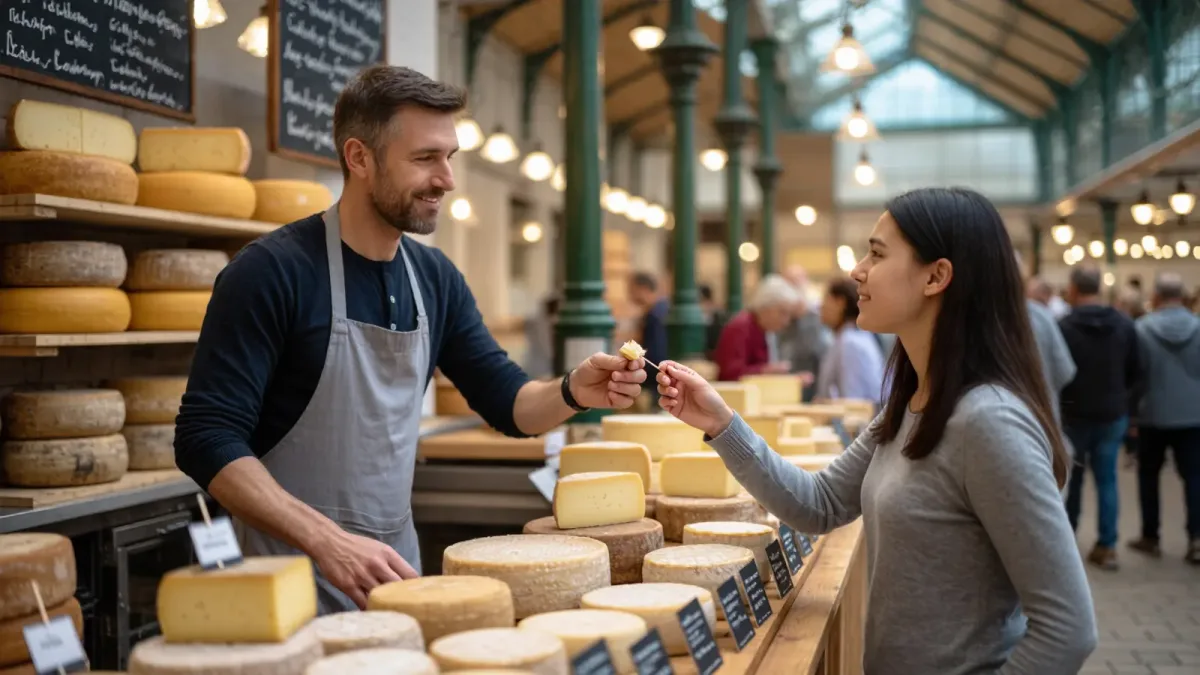
- Let the vendor lead. If a sample is offered, taste it; if not, ask — "may I try one?" is welcome at cheese, fruit, and charcuterie stalls and grudging at others.
- Buy after tasting, not before. Tasting five things and buying nothing once is human; doing it every Saturday is not.
- Point and quantity. "Two of these, one of those" with a pointed finger works in every market on the continent; vendors complete the sentence.
- Accept the vendor's pick. At produce stalls, the seller chooses the fruit — it is their reputation. Resisting the selection reads as distrust.
- Small is fine. A 100-gram purchase of cheese or two tomatoes is a normal transaction, not an insult.
What Should a Traveler Buy at a Market?
Three categories earn their basket space. First, what the region grows: the market's center stalls — the ones with queues of locals — sell the terroir, and the souvenired periphery sells the same ceramics every city sells. Second, picnic inventory: bread, cheese, charcuterie, fruit, and a bottle from the market build a lunch for two at a fraction of a restaurant's price, and parks exist for precisely this. Third, the prepared-food stands: many markets run cooked-food counters at lunch, and these serve the market's own community, which makes them the most honest restaurant in the district.
What Are the Common Market Mistakes?
| Mistake | Fix |
|---|---|
| Arriving at noon on Saturday expecting atmosphere, not crowds | Weekday, 09:00–11:00 |
| Handling produce yourself | Ask; the vendor picks |
| Shopping with a fixed list from home | Buy what is best today; the market moves |
| Skipping the queue discipline | Note who arrived first; stalls serve in order |
| Photographing stalls without buying or asking | Buy something small, or ask first |
The last row matters more each year: a market is a workplace, and the stalls with the best produce are the ones most photographed by people who buy nothing.
How Many Times Should a Market Be Visited?
Once for orientation, once for shopping — the standing advice of market regulars, and it holds for travelers. The first pass maps the hall and shows what is strong; the second, ideally the next morning, is when real buying happens, because the vendor remembers a face and the traveler knows which stall deserves the budget. A single visit is still worthwhile; it should just be planned as a look with one purchase, not a shop.
FAQ
Do market vendors speak English?
In larger city markets, usually enough for quantities and prices; the numbers and "this one, please" carry the transaction. Learning the local words for the market's main products — cheese, bread, fish — earns visible goodwill everywhere.
Is it rude to negotiate prices at a food market?
At European food markets, yes — prices on staple produce are fixed and bargaining reads as strange. Discounts come instead as vendor's choice extras at the end of a friendly purchase, particularly near closing.
Can market food be eaten on the spot?
At prepared-food and bakery stands, yes — that is their business. At produce and butchery stalls, food is sold to take away; eating while shopping is poor form, and picnic tables where provided are the intended compromise.
What is the best budget strategy at a city market?
Shop the picnic formula: bread, one cheese, one cured meat, seasonal fruit, and water. For two people it costs roughly €15–€25 and replaces a restaurant meal without leaving the market's own logic (typical price levels, January 2026).