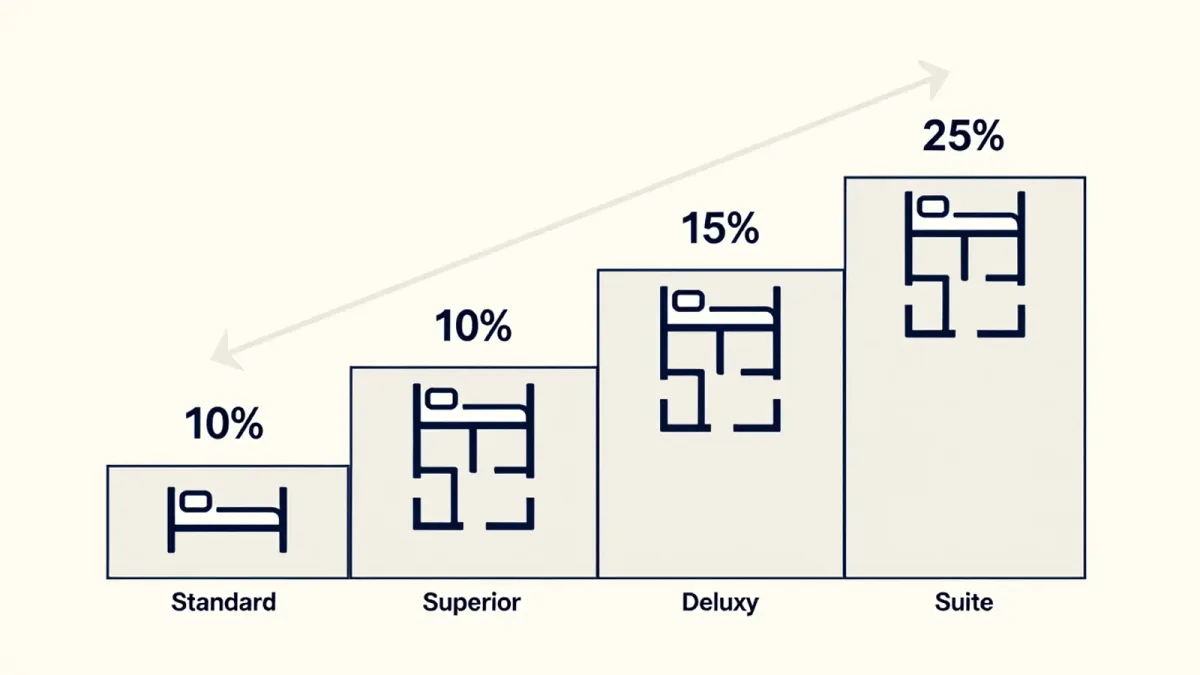
"Standard," "superior," "deluxe," and "suite" are not global classifications; they are marketing ladders within a single property, and a "superior" in one hotel can be smaller than a "standard" in the one across the street. What transfers between hotels is only the measurable language: floor area in square meters or square feet, bed width, occupancy, and listed facilities. A survey of listings on major platforms shows city hotels commonly price the steps of their internal ladder 10 to 25 percent apart, so knowing what each step actually adds is worth real money (published rate ladders as of August 2026). This guide decodes the common vocabulary and lists the measurements that make comparisons honest.
This site publishes information, not booking advice; definitions are per property, so read the listed dimensions rather than the name.
What Do the Category Names Usually Mean?
Within any one hotel, the ladder generally runs like this, though nothing compels a property to follow it:
- Standard: the base product — the smallest rooms, usually the least desirable aspect (street-facing, lower floors), one bathroom, the essentials complete.
- Superior: a step up in size or aspect — often the same room type on a better floor, with a view, or marginally larger. The weakest value step: small gain, real supplement.
- Deluxe: meaningfully larger rooms or better position; at many properties, the first category with a sitting corner or a bathtub.
- Junior suite / suite: a separate sleeping and sitting area; a true suite has a door or wall between them. Suites are sold as apartments in miniature, not as bigger bedrooms.
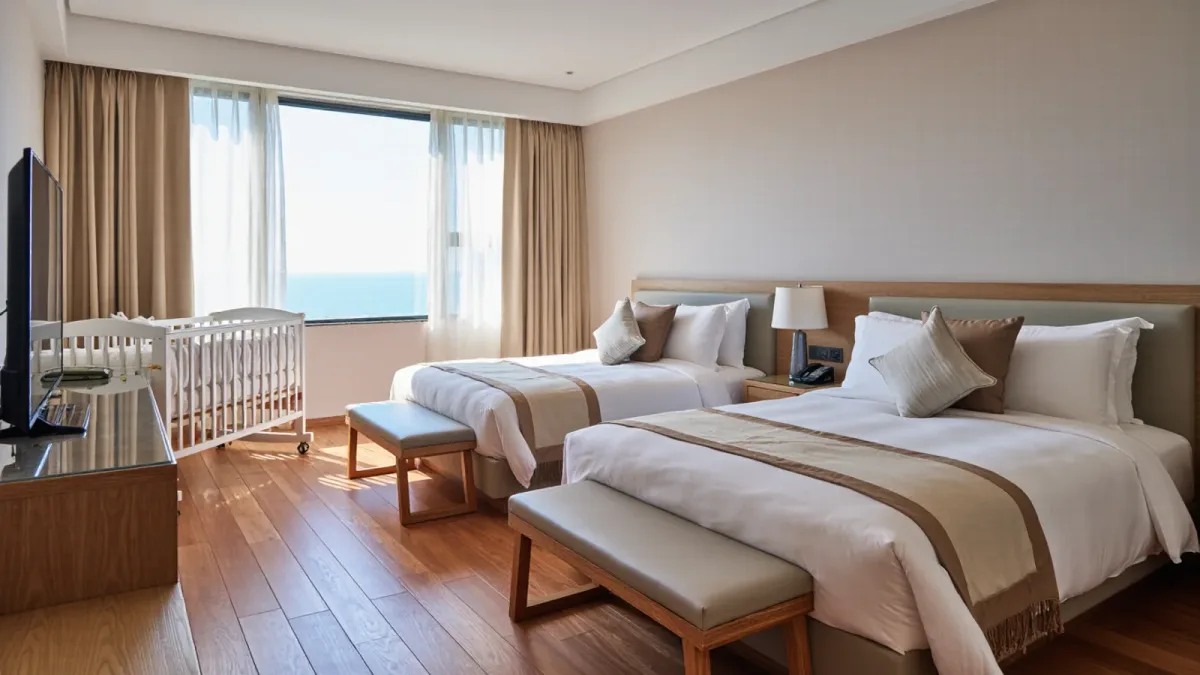
- Family room: defined occupancy for three or four, often a sofa bed as the third and fourth berth — check who sleeps on it.
Why Do Names Mislead Between Hotels?
Because the words grade a hotel against itself. A 16-square-meter "standard" is comfortable in a compact older city building and tight in a resort tower; the same property may call 20 square meters "deluxe" while a neighbor calls 18 "standard." The honest units of comparison, printed on every transparent listing: floor area, bed width (a "double" can be two twins pushed together or a true 160–180 cm bed — a frequent European surprise), occupancy, bathroom details, and aspect. Two minutes with those numbers beats any category name.
What Do Bed Terms Actually Describe?
| Term | Common meaning | What to check |
|---|---|---|
| Twin | Two single beds | Whether they can be joined |
| Double | One bed for two | Width: 140 cm tight, 160–180 cm comfortable |
| Queen / king | Wide double, US-derived terms | European listings vary; trust the centimeters |
| Double-double | Two large beds, family use | Occupancy allowed, not just beds |
| Sofa bed | Third/fourth berth in family rooms | Mattress quality; who sleeps there |
The classic European trap: "double bed" meaning two 90-centimeter singles with a gap, dressed as one. Bed width in centimeters appears on good listings; its absence is a question for the property (listing practice, August 2026).
When Is the Upgrade Worth It?
Three cases earn their supplement. First, length of stay: an extra 6 square meters repays itself across five nights of living out of a suitcase. Second, working trips: a desk corner or a separate sitting area changes the room's usefulness more than its name suggests. Third, aspect upgrades at the top of the ladder: where "deluxe" buys the courtyard-and-high-floor combination, it buys sleep, which no other amenity matches. The upgrade that rarely pays: "superior" — one step up, often just a better floor at a 15 percent premium.
How Can a Category Be Verified Before Booking?
- Read the listed square meters and bed width, not the name.
- Check the room photos' captions — properties that label photos by room number invite comparison of best to worst.
- Search reviews for the exact category name; guests report "standard is tiny" with notable reliability.
- Email the property for the floor plan when size matters; front desks answer measurement questions plainly.
FAQ
Is a suite always two rooms?
A true suite has a separate living space, by custom divided from the bedroom by a wall or door; a "junior suite" is one large room with a sitting zone. Definitions are informal — check the listed layout and square meters rather than the label.
What is the difference between superior and deluxe?
Within one hotel: superior is usually a minor step — aspect or a few square meters — and deluxe a real one, adding size, a bathtub, or a sitting corner. Between hotels the words mean nothing comparable.
Does a higher category guarantee a better view?
Not unless the rate name says so. View assignments are a separate axis from category; a standard room with a named view can outrank a deluxe facing a shaft. The view, if paid for, belongs in the rate name.
How big should a standard double be?
For two adults with luggage, 16–18 square meters is workable for a short stay in Europe, under 14 is tight, and 20-plus is comfortable. Bed width of 160 cm or more matters as much as floor area (listed dimensions, August 2026).