Le Marais is the most walkable single district in central Paris: a medieval street grid between the Hôtel de Ville and the Bastille, anchored by the Place des Vosges and a cluster of free-entry municipal museums, and best covered on foot in a single long day — though two half-days suit it better. The name means "the marsh," the swampy ground the religious orders drained in the 12th and 13th centuries; the aristocracy built grand hôtels particuliers here in the 17th, and when they moved to Versailles and Faubourg Saint-Germain, the quarter's mansions survived as workshops, warehouses, and — from the 1960s, after the 1962 Malraux Law made protective restoration a national policy — restored historic monuments. This primer covers the district's layout and character and the practicalities of a visit. Selections are chosen for walkability, variety, and price range as listed in January 2026.
As ever, this site publishes information, not professional travel advice; opening hours and prices change, so confirm before you go.
Where exactly is the Marais, and how is it laid out?
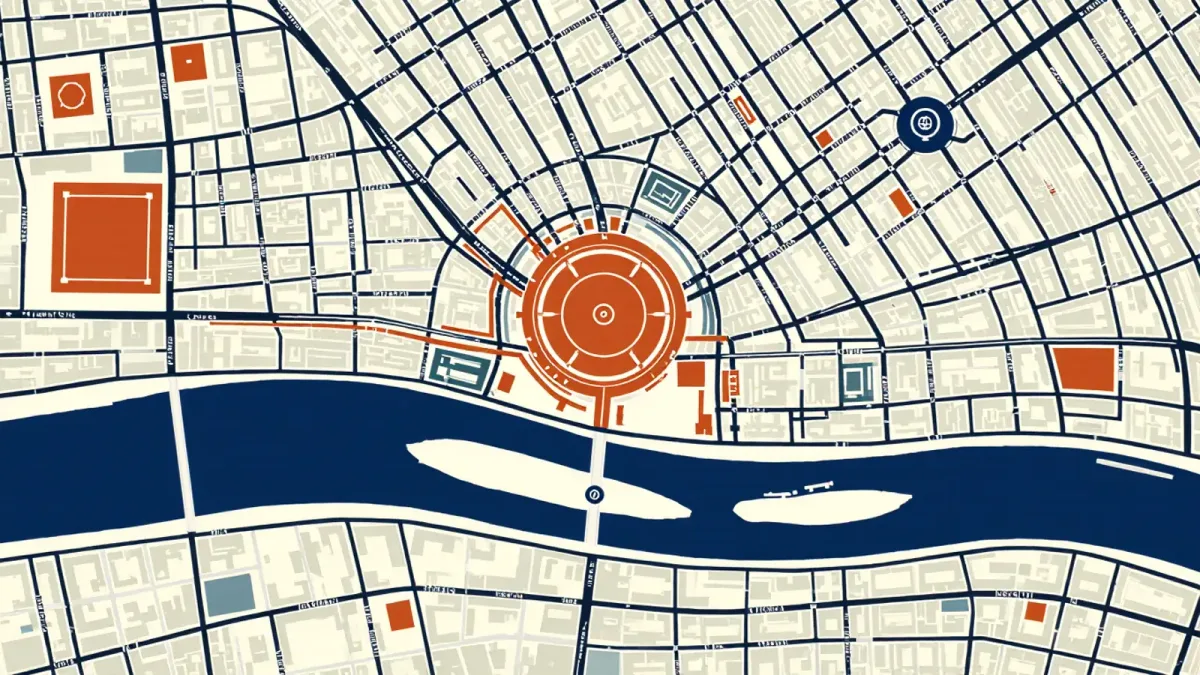
The Marais spans parts of the 3rd and 4th arrondissements on the Right Bank, bounded roughly by the Seine to the south, the rue de Rivoli to the north, and the Place de la Bastille to the east. Its defining feature is that Haussmann barely touched it: the street plan predates the 19th-century boulevards, so the district reads narrow, crooked, and intimate compared with the rest of central Paris. Rue des Rosiers is the historic spine of the old Jewish quarter in its eastern half; rue des Francs-Bourgeois runs west toward the Place des Vosges through a corridor of mansion courtyards; and rue de Turenne marks the quieter residential western edge. The district is largely flat, an exception on the Right Bank, which makes it the easiest long walk in central Paris.
What should you see in a day?
- Place des Vosges. Paris's oldest planned square, built under Henri IV and completed in 1612, a perfectly symmetrical red-brick arcades ring with a garden at its center. Victor Hugo's house at No. 6 is a free-entry city museum as of January 2026.
- The Carnavalet Museum. The city of Paris's own history museum, free for the permanent collections, closed Mondays, and the single best orientation to everything else you are looking at.
- Rue des Rosiers and the Pletzl. The historic Jewish quarter, with delis, bookshops, and the Musée d'Art et d'Histoire du Judaïsme in the Hôtel de Saint-Aignan.
- The Pompidou Centre's western edge. The district brushes against the Beaubourg piazza; the museum itself closed for renovation in 2025, with reopening announced for 2030, so plan the piazza and the surrounding streets rather than the galleries.
What does the district cost?
The Marais spans every price band, but its default register is mid-range with accessible anchors. The municipal museums are free for permanent collections; the arcades of the Place des Vosges and the district's courtyards cost nothing; and the rue des Rosiers falafel counters and boulangeries cover lunch at street-food prices, typically €8–12 as listed in January 2026. Boutiques and galleries run the full range above that, and dinner ranges from neighborhood bistros to tasting-menu rooms in restored mansions. The criterion across selections here remains location, walkability, and price range rather than any ranking.
How does the Marais fit a Paris city break?
The Marais pairs naturally with the islands: cross the Pont Marie from the district's southern edge and you are on Île Saint-Louis in five minutes. For a first Paris break, it works as the daytime anchor — museums and wandering — with evenings spent elsewhere; for a return visit, its independent shops, falafel counters, and courtyard museums justify two full half-days. Unlike most central districts, it does not empty at midday or shut on Sundays: the boutiques and many food shops trade seven days, a quirk of the district's commercial character noted by the Paris tourist office as of 2025.
What makes it different from the other central districts?
Three things. First, the street plan: pre-Haussmann, so the district rewards wandering in a way the boulevards do not — you can cross it diagonally through passages and courtyards a map barely shows. Second, the density of city museums: Carnavalet, the Victor Hugo house, the Picasso Museum, and the Memorial de la Shoah all sit within the same fifteen-minute footprint, an intensity no other Right Bank district matches. Third, its weekly rhythm: the district trades on Sundays when most of Paris does not, which reshuffles a weekend itinerary — the Marais is the Sunday plan, not the Monday one. For a traveler building a Paris break around neighborhoods rather than a checklist, these differences are precisely the point.
When should you go, and what should you know?
Weekday mornings are the quiet window; Saturday afternoons along rue des Rosiers are the district's most crowded hour. Most museums in the district close Mondays or Tuesdays — the Carnavalet closes Mondays — so check against your dates. The Saint-Paul métro station (line 1) is the practical entrance, with the Chemin Vert and Bastille stations at the district's other corners.