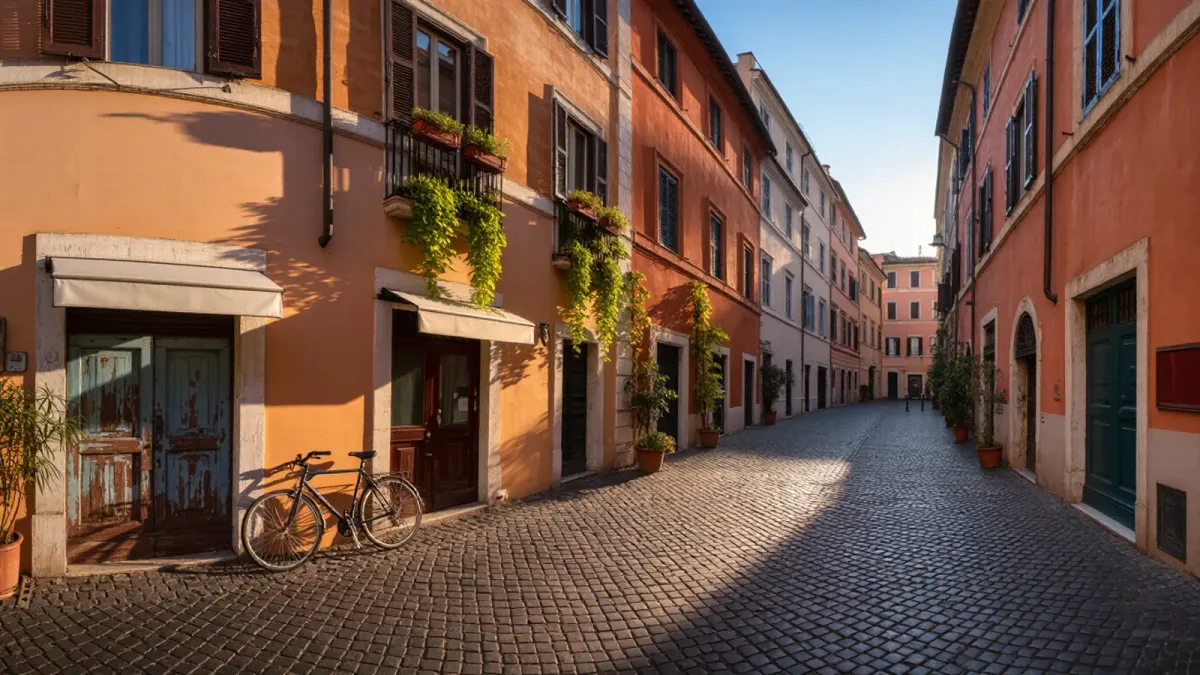
Trastevere is the best-preserved slice of old Rome on foot: a quarter of ivy-draped lanes, ochre houses, and trattorias on the Tiber's left bank — strictly the right bank, but the "left" of the Roman habit of facing the Campus Martius — best visited on a weekday morning or after 21:00, and covered end to end in a half-day plus one evening. The name means "across the Tiber" (tras tevere), and the district kept its working-class, fisherman-and-mason character for two millennia while the marble center rebuilt itself around it; the cobbled, irregular street plan that survived is precisely what the rest of central Rome lost. This primer covers layout, character, and practicalities. Selections are chosen for walkability, variety, and price range as listed in March 2026.
This site publishes information, not professional travel advice; hours and prices change, so confirm before you go.
Where is Trastevere, and how is it laid out?
The district occupies the rising ground between the river and the Janiculum hill in Rome's 13th rione. Its two spines run roughly parallel: Viale di Trastevere, the broad 19th-century avenue with the tram from the center, and the lane-web south of it around Via della Lungaretta, where the medieval grid survives intact. Santa Maria in Trastevere and its piazza sit at the heart; Piazza Trilussa, across the Ponte Sisto footbridge, is the district's riverside front door and its evening gathering point. Everything of interest lies within a 20-minute walk of the Ponte Sisto, which in turn is a 10-minute walk from Campo de' Fiori on the historic side — the bridge is the single most useful crossing in central Rome for a district-based break.
What should you see?
- Santa Maria in Trastevere. The district's founding church, among the oldest in Rome dedicated to the Virgin, with 12th-century gold mosaics in the apse attributed to Pietro Cavallini's circle and a 13th-century facade. Entry is free as of March 2026; modest dress applies.
- The Janiculum and its terrace. The climb from the district's western edge, or a bus up Viale delle Mura Aurelie, reaches the Fontanone terrace and Garibaldi monument with the widest panorama over the rooftops of Rome. The cannon fired from the hill at noon daily is a 1904 tradition still observed.
- Villa Farnesina. Raphael's frescoed loggia — the Triumph of Galatea among them — in a Renaissance villa on the river edge, quieter than any Vatican gallery. As of 2026 it opens daily except certain holidays, with modest entry fees.
- The lanes themselves. The block between Via della Lungaretta, Via del Moro, and the Botanical Garden's boundary is the postcard: laundry, ochre walls, workshop doorways. The Orto Botanico, the university's garden on the district's slopes, offers shade and terracing for a coin's admission.
And on a Sunday?
Sunday morning brings the Porta Portese flea market to the district's river edge, a secondhand market running along Via Portuense and the avenues by the old gate since the postwar years — records, bicycle parts, linens, and the general archaeology of Roman households. It is a genuine local institution rather than a souvenir market, busiest from about 08:00 to 13:00 as of 2026 practice, and it reshuffles the district's geography for a morning: the market end draws the crowd while the lanes around Santa Maria empty out, which inverts the usual density. Pair it with lunch inland and the Janiculum climb in the afternoon, and the district covers a full Sunday without once crossing the river.
How does Trastevere fit a Rome city break?
It serves two roles. As a daytime district, it pairs with the historic center across the bridge — the Campo de' Fiori, Piazza Navona, and the Jewish Ghetto all sit within a 15-minute walk of Ponte Sisto, so the district slots naturally into a center-heavy day as the lunch and wandering hour. As an evening district, it is Rome's most reliable dinner quarter: trattorias cluster at every price band from pizza al taglio by the slice to multi-course family institutions, and the Piazza Trilussa steps fill after 21:00. The honest caveat is popularity: on summer weekend evenings the core lanes reach a density closer to a fair than a neighborhood, which is why the morning — before the shops of the center even open — is the district's best-kept window.
What should you know before going?
Three practical points. The 8 tram down Viale di Trastevere connects the district to Argentina in the center in about ten minutes and runs frequently as of 2026; the metro does not serve Trastevere at all. The cobblestones — the distinctive basalt sampietrini — are charming and hard on wheels and ankles alike, so pack accordingly. And the district's restaurants: the ones on the piazza fronts charge a premium for the view, while the same cooking costs meaningfully less two lanes inland; a table booked by phone a day ahead on weekends remains the norm at the better-known trattorias.