Star ratings and the word "boutique" measure different things, and confusing them is the most common booking mistake on a city break. A hotel's stars grade facilities and service standards — a five-star property must offer certain amenities around the clock — while a boutique hotel is defined by size and design intent, typically under roughly 100 rooms, with individual decor and a bar or restaurant that often serves the neighborhood. Neither label guarantees a better night's sleep. This comparison rests on published national hotel classification criteria and property listings as of January 2026, chosen for service standards, location, and price range.
This site publishes information, not booking advice; classification systems vary by country, so verify what stars mean at the destination before paying.
What Do Hotel Stars Actually Grade?
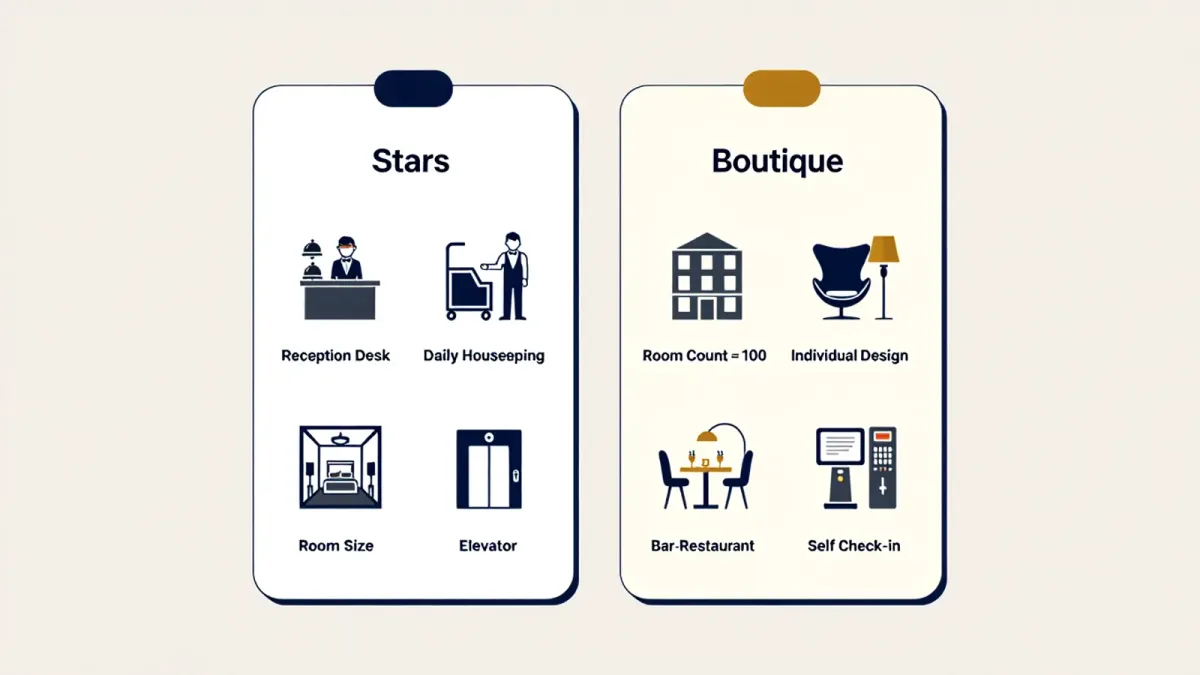
Most European countries run official or industry classification schemes that inspect properties on point systems: room size, bathroom fixtures, reception hours, elevator, air conditioning, language capabilities of staff. A four-star rating, in most schemes, requires a staffed front desk with defined hours, daily housekeeping, and en-suite facilities of a specified standard. What stars do not grade is noise, charm, neighborhood, or whether the building has character. A traveler comparing a two-star and a four-star in the same district is comparing inspected facility levels, not guaranteed comfort.
What Does "Boutique" Actually Mean?
Boutique has no legal definition. In practice the label signals a small property — commonly 10 to 100 rooms — with individual design, a distinct identity, and often a destination bar or restaurant. The trade is structural: fewer rooms mean fewer staff on shift, reception may close overnight, housekeeping may be less frequent, and there is rarely a gym, pool, or business center. What the guest buys is atmosphere and location; boutique properties cluster in converted townhouses and former office buildings in the older, walkable districts where large-footprint hotels cannot fit.
Where Each Type Fails?
| Failure point | Star-rated chain | Boutique property |
|---|---|---|
| Late arrival | Desk staffed; room held | Self check-in code or night porter, varies |
| Noise | Uniform builds, standardized glazing | Converted buildings, thin walls possible |
| Room consistency | Chain standards, few surprises | Rooms differ; photos may show the best one |
| Service depth | Concierge, luggage, 24h desk at upper tiers | Personal but thin; small team |
| Price at peak | Predictable corporate bands | Character commands a premium |
None of this makes one type better. It makes them suited to different trips: a late-arriving first-time visitor is better served by the chain's guaranteed desk, while a repeat visitor who plans to be out from morning to midnight may find the chain's facilities pointless.
How Should a Traveler Decide?
- Arriving after 21:00 or leaving before 07:00: weight a staffed desk heavily, whatever the style.
- Traveling for a design-first trip and eating out every meal: boutique's trade works in the traveler's favor.
- Needing luggage storage, early breakfast, or a family configuration: upper-tier chains handle these as routine.
- Reading boutique listings: check review volume and dates, and look for mentions of street noise and check-in mechanics rather than decor.
Price bands overlap almost completely. In major European capitals in low season, well-reviewed boutique doubles and upper-tier chain doubles both list from roughly €130 to €260 per night (published rates on major platforms, January 2026), so the decision rarely saves money — it allocates it.
Does the Star System Differ by Country?
Yes, materially. Classification is national: hotelstars Union criteria govern Germany, Austria, and several neighbors, while France, Italy, and Spain run separate state schemes, and the same star count can describe different facility levels across borders. A four-star in one country may require air conditioning that another country's four-star need not offer. Cross-border comparison should rely on the property's listed facilities and recent reviews rather than the star count alone.
FAQ
Is a boutique hotel always more expensive than a chain?
No. Price bands overlap almost fully in most European cities; small independent properties outside the design segment can undercut chains, while design-led boutiques in prime districts can exceed them. Compare specific properties, not categories (rates as listed, January 2026).
Do boutique hotels have 24-hour reception?
Often not. Many operate reduced desk hours with self check-in codes or a night porter. The listing states the arrangement; confirm it before booking any arrival after 21:00.
Are stars awarded officially or by the hotels themselves?
It depends on the country. Several European schemes are official or state-supervised with inspections; others are industry self-assessment against published criteria. The scheme's own site names its process.
Which is quieter, a chain or a boutique?
Neither by definition. Chains offer standardized builds, but a chain room over a nightlife street is loud, and a boutique in a residential courtyard can be silent. Reviews mentioning noise, plus a request for a courtyard-facing or high floor room, beat any category label.